Friday, July 28, 2023

07 Religious Icons, The Meister von Meßkirch's Falkenstein Altar, Saint Anne, Saint Elmo, Saint George, Saint Christopher, Roch, John the Baptist and Andrew the Apostle, with footnotes #36

Master of Messkirch  (fl. 1520–1540)
Falkenstein Altarpiece, c. after 1530
Tempera on softwood
Johanniterkirche, Johanniterhalle Schwäbisch Hall

The Master of Meßkirch (German: Meister von Meßkirch; active c. 1515 - 1540) was an anonymous German Renaissance painter.

The so-called Master of Meßkirch is named after the eleven altarpieces he painted for the St. Martin church in Meßkirch between 1536 and 1540. His birthplace and apprenticeship are unknown, but he may have studied under an artist from the circle of Albrecht Dürer, such as Hans von Kulmbach or Hans Leonhard Schäufelein. From the 1530s onwards his works seem to display familiarity with contemporary northern Italian paintings. 

Throughout the master's career his figures had Manneristic proportions. While early on his colors were bright and iridescent, his coloration became calmer and more muted in his last years. More on The Master of Meßkirch

Master of Messkirch  (fl. 1520–1540)
Falkenstein Altarpiece, c. after 1530
Top Center; Virgin, Child and St Anne

Saint Anne (also known as Ann or Anna) of David's house and line, was the mother of the Virgin Mary and grandmother of Jesus Christ, according to apocryphal Christian and Islamic tradition. Mary's mother is not named in the canonical gospels, nor in the Qur'an. Anne's name and that of her husband Joachim come only from New Testament apocrypha, of which the Protoevangelium of James (written perhaps around 150) seems to be the earliest that mentions them. More on Saint Anne

Master of Messkirch  (fl. 1520–1540)
Falkenstein Altarpiece, c. after 1530
Soft wood
height: 49 cm (19.2 in); width: 27 cm (10.6 in)
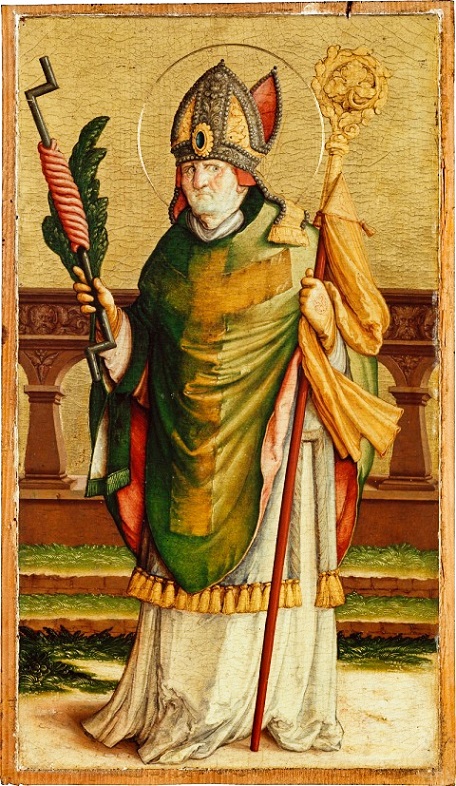
Top Right; St. Erasmus

Erasmus of Formia, also known as Saint Elmo (died c. 303), was a Christian saint and martyr. He is venerated as the patron saint of sailors and abdominal pain. Erasmus or Elmo is also one of the Fourteen Holy Helpers, saintly figures of Christian tradition who are venerated especially as intercessors. More on St. Erasmus

Master of Messkirch  (fl. 1520–1540)
Falkenstein Altarpiece, c. after 1530
Soft wood
height: 49 cm (19.2 in); width: 27 cm (10.6 in)
Top Left; St. George


Saint George (circa 275/281 – 23 April 303 AD) was a soldier in the Roman army who later became venerated as a Christian martyr. His parents were Christians of Greek background; his father Gerontius was a Roman army official from Cappadocia and his mother Polychronia was from Lydda, Syria Palaestina. Saint George became an officer in the Roman army in the Guard of Diocletian, who ordered his death for failing to recant his Christian faith.
 
In the fully developed Western version of the Saint George Legend, a dragon, or crocodile, makes its nest at the spring that provides water for the city of "Silene" (perhaps modern Cyrene in Libya or the city of Lydda in Palistine, depending on the source). Consequently, the citizens have to dislodge the dragon from its nest for a time, to collect water. To do so, each day they offer the dragon at first a sheep, and if no sheep can be found, then a maiden is the best substitute for one. The victim is chosen by drawing lots. One day, this happens to be the princess. The monarch begs for her life to be spared, but to no avail. She is offered to the dragon, but then Saint George appears on his travels. He faces the dragon, protects himself with the sign of the Cross, slays the dragon, and rescues the princess. The citizens abandon their ancestral paganism and convert to Christianity. More on Saint George 

Master of Messkirch  (fl. 1520–1540)
Falkenstein Altarpiece, c. after 1530
Soft wood
height: 49 cm (19.2 in); width: 27 cm (10.6 in)
Bottom Left: St. Christopher

Saint Christopher is venerated as a martyr killed in the reign of the 3rd-century Roman Emperor Decius,) or alternatively under the Roman Emperor Maximinus II Dacian. There appears to be confusion due to the similarity in names "Decius" and "Dacian". However his veneration only appears late in Christian tradition, and did not become widespread in the Western Church until the Late Middle Ages, although churches and monasteries were named after him by the 7th century.

It is disputed whether Christopher existed, and if so whether the name applied to a specific person or was a general title meaning "Christ-bearer" which was applied to several different real or legendary people. He may be the same figure as Saint Menas. His most famous legend, which is mainly known from the West and may draw from Ancient Greek mythology, tells that he carried a child, who was unknown to him, across a river before the child revealed himself as Christ. Therefore, he is the patron saint of travelers. More Saint Christopher

Master of Messkirch  (fl. 1520–1540)
Falkenstein Altarpiece, c. after 1530
Soft wood
height: 49 cm (19.2 in); width: 27 cm (10.6 in)
Bottom Right: St. Rochus

Roch (lived c. 1348 – 15/16 August 1376/79), also called Rock in English, is a Catholic saint, a confessor whose death is commemorated on 16 August and 9 September in Italy; he is especially invoked against the plague. He has the designation of Rollox in Glasgow, Scotland, said to be a corruption of Roch's Loch, which referred to a small loch once near a chapel dedicated to Roch in 1506.

He is a patron saint of dogs, invalids, of falsely accused people, bachelors, and several other things. He is the patron saint of Dolo (near Venice) and Parma, as well as Casamassima, Cisterna di Latina and Palagiano (Italy).

Saint Roch is known as "São Roque" in Portuguese, as "Sant Roc" in Catalan, as "San Roque" in Spanish (including in former colonies of the Spanish colonial empire such as the Philippines) and as "San Rocco" in Italian. More on Saint Roch

Master of Messkirch  (fl. 1520–1540)
Falkenstein Altarpiece, c. after 1530
Soft wood
height: 49 cm (19.2 in); width: 27 cm (10.6 in)
Bottom second from left: St. John the Baptist

The story of John the Baptist is told in the Gospels. John was the cousin of Jesus, and his calling was to prepare the way for the coming of the Messiah. He lived in the wilderness of Judea between Jerusalem and the Dead Sea, "his raiment of camel's hair, and a leather girdle about his loins; and his meat was locusts and wild honey." He baptised Jesus in the Jordan.

According to the Bible, King Herod's daughter Salome requested Saint John the Baptist's beheading. She was prompted by her mother, Herodias, who sought revenge, because the prophet had condemned her incestuous marriage to Herod. More John the Baptist

Master of Messkirch  (fl. 1520–1540)
Falkenstein Altarpiece, c. after 1530
Soft wood
height: 49 cm (19.2 in); width: 27 cm (10.6 in)
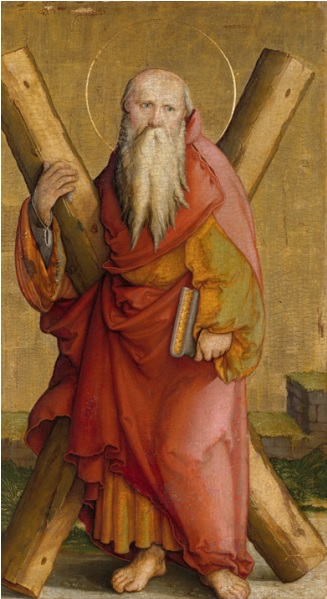
Bottom second from right: St. Andrew

Andrew the Apostle (from the early 1st century – mid to late 1st century AD), also known as Saint Andrew was a Christian Apostle and the brother of Saint Peter.
The name "Andrew", like other Greek names, appears to have been common among the Jews, Christians, and other Hellenized people of Judea. No Hebrew or Aramaic name is recorded for him. According to Orthodox tradition, the apostolic successor to Saint Andrew is the Patriarch of Constantinople. More Andrew the Apostle 

The Master of Meßkirch (active c. 1515 - 1540) was an anonymous German Renaissance painter.

The so-called Master of Meßkirch is named after the eleven altarpieces he painted for the St. Martin church in Meßkirch between 1536 and 1540. His birthplace and apprenticeship are unknown, but he may have studied under an artist from the circle of Albrecht Dürer, such as Hans von Kulmbach or Hans Leonhard Schäufelein. From the 1530s onwards his works seem to display familiarity with contemporary northern Italian painting. Hans Baldung Grien was also influential to his work.

Early on he worked for Count Eitel Friedrich III of Hohenzollern in Veringenstadt. Later he was called to Meßkirch to work for Count Gottfried Werner von Zimmern.

Throughout the master's career his figures had Manneristic proportions. While early on his colors were bright and iridescent, his coloration became calmer and more muted in his last years. More on The Master of Meßkirch


Please visit my other blogs: Art CollectorMythologyMarine ArtPortrait of a Lady, The OrientalistArt of the Nude and The Canals of VeniceMiddle East Artists365 Saints365 Days, and Biblical Icons, also visit my Boards on Pinterest

Images are copyright of their respective owners, assignees or others. Some Images may be subject to copyright

I don't own any of these images - credit is always given when due unless it is unknown to me. if I post your images without your permission, please tell me.

I do not sell art, art prints, framed posters or reproductions. Ads are shown only to compensate the hosting expenses.

If you enjoyed this post, please share with friends and family.

Thank you for visiting my blog and also for liking its posts and pages.

Please note that the content of this post primarily consists of articles available from Wikipedia or other free sources online.


Monday, July 10, 2023

01 Religious Icon, The Meister von Meßkirch's St. Benedict in Prayer, with footnotes #35

The Meister von Meßkirch
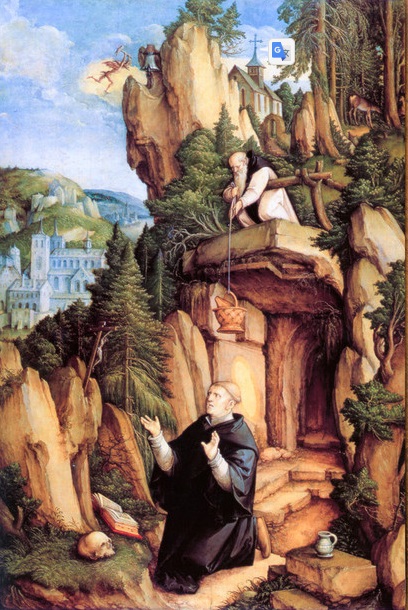
St. Benedict in Prayer
8"x12"
Private collection

The image shows St. Benedict praying in a cave on Mount Subasio which he fled to to escape the debauchery associated with higher education in Rome. He led a very austere life, is known for his power against demons, and is considered the Father of Western Monasticism. More on this icon

Saint Benedict founded twelve communities for monks at Subiaco, Lazio, Italy, before moving to Monte Cassino in the mountains of southern Italy. The Order of Saint Benedict is of later origin and, moreover, not an "order" as commonly understood but merely a confederation of autonomous congregations.

Benedict's main achievement, his "Rule of Saint Benedict", contains a set of rules for his monks to follow. Heavily influenced by the writings of John Cassian, it shows strong affinity with the Rule of the Master, but it also has a unique spirit of balance, moderation and reasonableness, which persuaded most Christian religious communities founded throughout the Middle Ages to adopt it. As a result, his Rule became one of the most influential religious rules in Western Christendom. For this reason, Giuseppe Carletti regarded Benedict as the founder of Western Christian monasticism. More on Saint Benedict

The Master of Meßkirch (active c. 1515 - 1540) was an anonymous German Renaissance painter.

The so-called Master of Meßkirch is named after the eleven altarpieces he painted for the St. Martin church in Meßkirch between 1536 and 1540. His birthplace and apprenticeship are unknown, but he may have studied under an artist from the circle of Albrecht Dürer, such as Hans von Kulmbach or Hans Leonhard Schäufelein. From the 1530s onwards his works seem to display familiarity with contemporary northern Italian painting. Hans Baldung Grien was also influential to his work.

Early on he worked for Count Eitel Friedrich III of Hohenzollern in Veringenstadt. Later he was called to Meßkirch to work for Count Gottfried Werner von Zimmern.

Throughout the master's career his figures had Manneristic proportions. While early on his colors were bright and iridescent, his coloration became calmer and more muted in his last years. More on The Master of Meßkirch


Please visit my other blogs: Art CollectorMythologyMarine ArtPortrait of a Lady, The OrientalistArt of the Nude and The Canals of VeniceMiddle East Artists365 Saints365 Days, and Biblical Icons, also visit my Boards on Pinterest

Images are copyright of their respective owners, assignees or others. Some Images may be subject to copyright

I don't own any of these images - credit is always given when due unless it is unknown to me. if I post your images without your permission, please tell me.

I do not sell art, art prints, framed posters or reproductions. Ads are shown only to compensate the hosting expenses.

If you enjoyed this post, please share with friends and family.

Thank you for visiting my blog and also for liking its posts and pages.

Please note that the content of this post primarily consists of articles available from Wikipedia or other free sources online.


Thursday, June 22, 2023

01 Religious Icon, A Russian icon of the holy empress Saint Alexandra, with footnotes #35

Unknown iconographer
The Holy Empress Saint Alexandra
With gilded silver oklad, by Ovchinnikov, Moscow, c. 1883
20 1/2 x 10 1/2 in., 52 x 26.7 cm
Private collection

The Saint shown standing at full length, richly dressed in gem- and pearl-studded clothing and crown, and holding a cross, with Christ shown in the clouds above her

Saint Alexandra was the reputed wife of Emperor Diocletian, from 284 until his abdication in 305,  and secretly converted to Christianity. Jacobus de Voragine listing her name as “Alexandria” describes her as the wife of Dacian, the Roman Prefect who persecuted Saint Caprasius of Agen and Saint Maginus. While Saint George was being tortured, Alexandra went to the arena, bowed before him, and professed her faith openly. When she questioned whether she was worthy of paradise and martyrdom without being baptized, Saint George told her, “Do not fear, for your blood will baptize you.” She was denounced as a Christian and imprisoned on her husband's orders in Nicomedia, then sentenced to death.

Her husband was so outraged by her conversion that he is said to have uttered, “What! Even thou hast fallen under their spell!”. Alexandra quietly accepted her sentence and prayed as the guards walked her to the place of execution. She asked if she could rest for a moment. The guards allowed this. She rested by the place of Saint George's execution at Nicomedia's City Wall. More on St. Alexandra

Pavel Akimovich Ovchinnikov was the bondman of Prince Volkonsky. He showed talent for drawing while being a child. Being a teenager he was sent to Moscow for eight years as an apprentice in the workshop, manufacturing gold and silver items, which belonged to his brother A.A. Ovchinnikov. As a brilliant student, P. Ovchinnikov was manumitted. In 1850, he married. Taking 1000 rubles as his wife dowry he opened a workshop which later turned into one of the major jewellery factories in Moscow. More on Pavel Akimovich Ovchinnikov


Please visit my other blogs: Art CollectorMythologyMarine ArtPortrait of a Lady, The OrientalistArt of the Nude and The Canals of VeniceMiddle East Artists365 Saints and 365 Days, also visit my Boards on Pinterest

Images are copyright of their respective owners, assignees or others. Some Images may be subject to copyright

I don't own any of these images - credit is always given when due unless it is unknown to me. if I post your images without your permission, please tell me.

I do not sell art, art prints, framed posters or reproductions. Ads are shown only to compensate the hosting expenses.

If you enjoyed this post, please share with friends and family.

Thank you for visiting my blog and also for liking its posts and pages.

Please note that the content of this post primarily consists of articles available from Wikipedia or other free sources online.

Monday, June 12, 2023

01 Religious Icon, A Russian icon of Christ Pantocrator, with footnotes #34

Unknown artist
Christ Pantocrator
Oil/tempera on panel, gilded silver, enamel
10 5/8 x 8 7/8 in., 27 x 23.5 cm
Private collection

In Christian iconography, Christ Pantocrator is a specific depiction of Christ. Pantocrator or Pantokrator, usually translated as "Almighty" or "all-powerful", is derived from one of many names of God in Judaism.

The Pantokrator, largely an Eastern Orthodox or Eastern Catholic theological conception, is less common under that name in Western (Roman) Catholicism and largely unknown to most Protestants. In the West, the equivalent image in art is known as Christ in Majesty, which developed a rather different iconography. Christ Pantocrator has come to suggest Christ as a mild but stern, all-powerful judge of humanity. More on Christ Pantocrator


Please visit my other blogs: Art CollectorMythologyMarine ArtPortrait of a Lady, The OrientalistArt of the Nude and The Canals of VeniceMiddle East Artists365 Saints365 Days, and Biblical Icons, also visit my Boards on Pinterest

Images are copyright of their respective owners, assignees or others. Some Images may be subject to copyright

I don't own any of these images - credit is always given when due unless it is unknown to me. if I post your images without your permission, please tell me.

I do not sell art, art prints, framed posters or reproductions. Ads are shown only to compensate the hosting expenses.

If you enjoyed this post, please share with friends and family.

Thank you for visiting my blog and also for liking its posts and pages.

Please note that the content of this post primarily consists of articles available from Wikipedia or other free sources online.


Friday, May 26, 2023

01 Religious Icon, A Russian icon of the Kazan Mother of God with gilded silver oklad, with footnotes #33

Unknown artist
Kazan Mother of God
Oil or tempera on panel, seed and artificial pearls, glass, silver
13 3/4 x 11 3/4 in., 34.8 x 29.7 cm
Private collection

Sold for 17,500 USD on April 2014

Our Lady of Kazan, also called Mother-of-God of Kazan, was a holy icon of the highest stature within the Russian Orthodox Church, representing the Virgin Mary as the protector and patroness of the city of Kazan, and a palladium of all of Russia and Rus', known as the Holy Protectress of Russia. As is the case for any holy entity under a Patriarchate in communion within the greater Eastern Orthodox Church, it is venerated by all Orthodox faithful.

According to legend, the icon was originally acquired from Constantinople, lost in 1438, and miraculously recovered in pristine state over 140 years later in 1579. Two major cathedrals, the Kazan Cathedral, Moscow, and the Kazan Cathedral, St. Petersburg, are consecrated to Our Lady of Kazan, and they display copies of the icon, as do numerous churches throughout the land. The original icon in Kazan was stolen, and probably destroyed, in 1904. More on Our Lady of Kazan


Please visit my other blogs: Art CollectorMythologyMarine ArtPortrait of a Lady, The OrientalistArt of the Nude and The Canals of VeniceMiddle East Artists365 Saints365 Days, and Biblical Icons, also visit my Boards on Pinterest

Images are copyright of their respective owners, assignees or others. Some Images may be subject to copyright

I don't own any of these images - credit is always given when due unless it is unknown to me. if I post your images without your permission, please tell me.

I do not sell art, art prints, framed posters or reproductions. Ads are shown only to compensate the hosting expenses.

If you enjoyed this post, please share with friends and family.

Thank you for visiting my blog and also for liking its posts and pages.

Please note that the content of this post primarily consists of articles available from Wikipedia or other free sources online.


Wednesday, May 17, 2023

01 Religious Icon, St. Luke presenting the Mother of God with the first icon, with footnotes #32

Unknown iconographer
St. Luke presenting the Mother of God with the first icon, circa 1800
Tempera on panel
15 1/2 x 13 3/4 in. (39.4 x 35 cm)
Private collection

The painted icon is covered with a metal cover, the borders with angels, set among floral garlands, raising up the image.

The Apostle Luke is mostly known as one of the four Evangelists. In fact, he told us more than the other three about our Lord’s childhood, as well as about His mother Mary.

It is a known fact that Saint Luke was also an artist. It is said, that he was the only person who painted a few images of the Theotokos while she was alive. This makes St Luke the first iconographer. 
However, some people believe that there is no proof that the icons in question have actually been painted by the Apostle.

The Bible doesn’t mention St Luke’s paintings. The only piece of information about Luke’s profession that the New Testament gives us is that the evangelist was a doctor. More on St. Luke presenting the Mother of God with the first icon


Please visit my other blogs: Art CollectorMythologyMarine ArtPortrait of a Lady, The OrientalistArt of the Nude and The Canals of VeniceMiddle East Artists365 Saints and 365 Days, also visit my Boards on Pinterest

Images are copyright of their respective owners, assignees or others. Some Images may be subject to copyright

I don't own any of these images - credit is always given when due unless it is unknown to me. if I post your images without your permission, please tell me.

I do not sell art, art prints, framed posters or reproductions. Ads are shown only to compensate the hosting expenses.

If you enjoyed this post, please share with friends and family.

Thank you for visiting my blog and also for liking its posts and pages.

Please note that the content of this post primarily consists of articles available from Wikipedia or other free sources online.


Friday, May 12, 2023

01 Religious Icon, Russian Icon of Our Lady of Vladimir, with footnotes #31

Unknown artist
Vladimir Mother of God with beaded cover, circa 1800
Tempera, glass beads, pearls, cotton
18 1/4 x 15 1/4 in. (46.3 x 38.5 cm)
Private collection

The miraculous image given the title, Our Lady of Vladimir, is known as an Eleousa, the Greek word meaning, Mother of Tenderness. The Christ Child nestles tenderly close to his mother, he gazes at her and is so closely linked to her that his left arm embraces her fully. His right hand gently touches her left cheek. The original image is a large painting of the type known as the St. Luke icons. Mary looks out at the people. Yet, there is no doubt that she is intimately united to her Divine Son.

The origin of the ancient Marian icon, Our Lady of Vladimir, can be traced back to 1125. For many, The Lady Who Saves Russia is the most loved image of the Eastern Church.

The oldest known representation of Our Lady of Vladimir is presently located at the Tretjakow Gallery in Moscow. According to research, this excellent representation of an Eleousa was commissioned in Constantinople by a Russian, who then had the painting taken from city to city during the period of united Ukranian-Russian history. In 1169, Duke Andrej Bogoljubskij had the icon brought from Kiev to the new cathedral of Vladimir. Due to the honor and reverence of the people, who attributed gracious assistance to Our Lady's help throughout the Ukraine, a large cathedral was built for her in Vladimir. More on Our Lady of Vladimir


Please visit my other blogs: Art CollectorMythologyMarine ArtPortrait of a Lady, The OrientalistArt of the Nude and The Canals of VeniceMiddle East Artists365 Saints and 365 Days, also visit my Boards on Pinterest

Images are copyright of their respective owners, assignees or others. Some Images may be subject to copyright

I don't own any of these images - credit is always given when due unless it is unknown to me. if I post your images without your permission, please tell me.

I do not sell art, art prints, framed posters or reproductions. Ads are shown only to compensate the hosting expenses.

If you enjoyed this post, please share with friends and family.

Thank you for visiting my blog and also for liking its posts and pages.

Please note that the content of this post primarily consists of articles available from Wikipedia or other free sources online.