Showing posts with label Ancient. Show all posts

Saturday, September 6, 2025

03 Religious Icons, Workshop of Andrea di Nerio's Nativity; Dormition of the Virgin and Assumption of the Virgin, with footnotes #51

Workshop of Andrea di Nerio
Nativity; Dormition of the Virgin and Assumption of the Virgin
Tempera on panel, gold ground
Private collection

Estimated for 40,000 - 60,000 USD in January 2023

Andrea di Nerio
Nativity
Tempera on panel, gold ground, shaped top
19⅝ by 16¼ in.; 49.8 by 41.3 cm.
Private collection

The nativity of Jesus, nativity of Christ, birth of Jesus or birth of Christ is described in the biblical gospels of Luke and Matthew. The two accounts agree that Jesus was born in Bethlehem in Judaea, his mother Mary was engaged to a man named Joseph, who was descended from King David and was not his biological father, and that his birth was caused by divine intervention. Many modern scholars consider the birth narratives unhistorical because they are laced with theology and present two different accounts which cannot be harmonised into a single coherent narrative. But many others view the discussion of historicity as secondary, given that gospels were primarily written as theological documents rather than chronological timelines. More on The nativity of Jesus

Andrea di Nerio
Dormition of the Virgin
Tempera on panel, gold ground, shaped top
21⅝ by 16⅜ in.; 54.9 by 41.6 cm.
Private collection

The Dormition of the Mother of God celebrates the "falling asleep" (death) of Mary the Theotokos.

Andrea di Nerio
Assumption of the Virgin
Tempera on panel, gold ground, shaped top
19⅝ by 16¼ in.; 49.8 by 41.3 cm.
Private collection

The dogma of the Assumption teaches that at the end of her time on earth, Mary was taken up—body and soul—into heaven. There, she sits at her Son’s right hand, as Queen of Heaven and Earth. The foundation for the teaching is rooted in Scripture, specifically in John’s mysterious and apocalyptic vision recorded in Revelation 12. 

Andrea di Nerio ( fl c. 1350s; d before 1387), was an Italian painter, long known only through meagre documents, this founder of the 14th-century Aretine school of painting was identified (1974–5 exh. cat.) through the discovery of his signature on an Annunciation panel probably painted for the Compagnia di SS Annunziata, Arezzo, in the 1350s. His authorship can now be established for a group of stylistically similar works formerly attributed to several hands, including the Master of the Vescovado and Spinello Aretino, who was doubtless Andrea’s pupil (and whose sculptor brother, Niccolò, married Andrea’s daughter, Rebecca). Andrea’s most distinguished works, combining the influence of Pietro Lorenzetti, Maso di Banco and Buffalmacco, include the poetic pair of predella panels with scenes from the Life of St John the Baptist (both Berne, Kstmus.) and the narrative frescoes in S Bartolomeo, Arezzo. His compositional clarity, incisive figure style and refined technique place him in the first rank of 14th-century Tuscan painters. More on Andrea di Nerio


Please visit my other blogs: Art Collector, Mythology, Marine Art, Portrait of a Lady, The Orientalist, Art of the Nude and The Canals of Venice, Middle East Artists, 365 Saints, 365 Days, and Biblical Icons, also visit my Boards on Pinterest and my art stores at  deviantart and Aaroko

Images are copyright of their respective owners, assignees or others. Some Images may be subject to copyright

I don't own any of these images - credit is always given when due unless it is unknown to me. if I post your images without your permission, please tell me.

Ads are shown only to compensate the hosting expenses.

If you enjoyed this post, please share with friends and family.

Thank you for visiting my blog and also for liking its posts and pages.

Please note that the content of this post primarily consists of articles available from Wikipedia or other free sources online.


Monday, July 7, 2025

1 Religious Icon, Marco Benefial, 17th Century Italian Masters' Flagellation Of Christ, with footnotes #50

After Marco Benefial, 17th Century Italian, Old Master, 
 The Flagellation Of Christ
Oil on canvas
16.5" x 12"
Private collection

Estimated for £500 GBP - £700 GBP in July 2022

Mid 18th-century copy after Benefial's composition in the Chiesa delle Santissime Stimmate di San Francesco in Rome.

The Flagellation of Christ, sometimes known as Christ at the Column or the Scourging at the Pillar, is a scene from the Passion of Christ very frequently shown in Christian art, in cycles of the Passion or the larger subject of the Life of Christ. It is the fourth station of the modern alternate Stations of the Cross, and a Sorrowful Mystery of the Rosary. The column to which Christ is normally tied, and the rope, scourge, whip or birch are elements in the Arma Christi. The Basilica di Santa Prassede in Rome, claimed to possess the original column. More on The Flagellation of Christ

Painting in 17th-century Italy was an international endeavor. Large numbers of artists traveled to Rome, especially, to work and study. They sought not only the many commissions being extended by the Church but also the chance to learn from past masters. Most of the century was dominated by the baroque style, whose expressive power was well suited to the needs of the Counter-Reformation Church for affecting images. More on Painting in 17th-century Italy

Marco Benefial (25 April 1684 – 9 April 1764) was an Italian, proto-Neoclassical painter, mainly active in Rome. Benefial is best known for his repudiation of 18th century decorative Rococo styles pre-eminent in the Rome dominated by Carlo Maratta pupils. His paintings portrayed tangible human figures, with complex treatment of space, and luminous, warm colors. Along with the altarpieces and frescoes, he also painted many portraits. Because he partnered with some inferior artists who subsequently received credit, some of his paintings have been frequently misidentified. More on Marco Benefial


Please visit my other blogs: Art Collector, Mythology, Marine Art, Portrait of a Lady, The Orientalist, Art of the Nude and The Canals of Venice, Middle East Artists, 365 Saints and 365 Days, also visit my Boards on Pinterest

Images are copyright of their respective owners, assignees or others. Some Images may be subject to copyright

I don't own any of these images - credit is always given when due unless it is unknown to me. if I post your images without your permission, please tell me.

I do not sell art, art prints, framed posters or reproductions. Ads are shown only to compensate the hosting expenses.

If you enjoyed this post, please share with friends and family.

Thank you for visiting my blog and also for liking its posts and pages.

Please note that the content of this post primarily consists of articles available from Wikipedia or other free sources online.


Wednesday, April 2, 2025

01 Religious Icon, Central Franconian Master's Saint Margaret of Antioch, with footnotes #46

Central Franconian Master, 1436
Scene from the Life of Saint Margaret of Antioch
Oil on panel
57 x 42 cm
Private collection

Sold for USD 39,000 .- in Nov 2022

St. Margaret of Antioch, also called St. Marina, (flourished 3rd or 4th century, Antioch, Syria), virgin martyr and was one of the most venerated saints during the Middle Ages. Her story, generally regarded to be fictitious, is substantially that of the Eastern St. Marina of Antioch and is related to that of St. Pelagia of Antioch, who is also known as Margaret or Marina.

During the reign (284–305) of the Roman emperor Diocletian, Margaret allegedly refused marriage with the prefect Olybrius at Antioch and was consequently beheaded after undergoing extravagant trials and tortures. Her designation as patron saint of expectant mothers and her emblem, a dragon, are based on one of her trials: Satan, disguised as a dragon, swallowed Margaret; his stomach, however, soon rejecting her, opened, and let her out unharmed. In 1969 Margaret’s feast day, formerly July 20, was eliminated in the revised calendar of the Roman Catholic Church because it is doubtful whether she ever existed. Nevertheless, during the medieval period she ranked among the most famous saints; her voice was among those attested to have been heard by St. Joan of Arc. More on St. Margaret of Antioch

Central Franconian Master is an unknown, highly skilled painter who worked in Franconia, a region in northern Bavaria (Germany) in the first quarter of the sixteenth century. The artist was familiar with the work of his famous contemporaries Albrecht Dürer and Lucas Cranach.


Please visit my other blogs: Art Collector, Mythology, Marine Art, Portrait of a Lady, The Orientalist, Art of the Nude and The Canals of Venice, Middle East Artists, 365 Saints, 365 Days, and Biblical Icons, also visit my Boards on Pinterest and my art stores at  deviantart and Aaroko

Images are copyright of their respective owners, assignees or others. Some Images may be subject to copyright

I don't own any of these images - credit is always given when due unless it is unknown to me. if I post your images without your permission, please tell me.

Ads are shown only to compensate the hosting expenses.

If you enjoyed this post, please share with friends and family.

Thank you for visiting my blog and also for liking its posts and pages.

Please note that the content of this post primarily consists of articles available from Wikipedia or other free sources online.

Monday, February 3, 2025

01 Religious Icon, Theotokos of Vladimir, the holy protectress of Russia, with footnotes #45

Unknown iconographer
Theotokos of Vladimir, c. 1130 in Constantinople
Tempera on panel
104 x 69 cm
Tretyakov Gallery

Theotokos of Vladimir. About 1131 the Greek Patriarch of Constantinople sent the icon as a gift to Grand Duke Yury Dolgorukiy of Kiev. The image was kept in a monastery, until Dolgorukiy's son Andrey Bogolyubskiy brought it to his favourite city, Vladimir, in 1155. Tradition tells that the horses transporting the icon stopped near Vladimir and refused to go further. People interpreted this as a sign that the Theotokos wanted her icon to stay in Vladimir. To house the icon, the great Assumption Cathedral was built there, followed by other churches dedicated to the Virgin throughout Ukraine. However the presence of the icon did not prevent the sack and burning of the city by the Mongols in 1238, when the icon was damaged by fire. It was first restored after this, and again before 1431 and in 1512.

According to the traditional accounts the image was taken from Vladimir to the new capital, Moscow, in 1395 during Tamerlane's invasion. Vasili I of Moscow spent a night crying over the icon, and Tamerlane's armies retreated the same day. The Muscovites refused to return the icon to Vladimir and placed it in the Cathedral of the Dormition of the Moscow Kremlin.

Crediting the icon with saving Moscow in 1395 does not appear in sources until the late 15th century, and the full version of the story until accounts of 1512 and then the 1560s. By the 16th century, the Vladimirskaya was a thing of legend, and associated with the growth of Russian national consciousness based on the Muscovite state. The intercession of the Theotokos through the image was credited also with saving Moscow from Tatar hordes in 1451 and 1480. More on Theotokos of Vladimir


Please visit my other blogs: Art Collector, Mythology, Marine Art, Portrait of a Lady, The Orientalist, Art of the Nude and The Canals of Venice, Middle East Artists, 365 Saints, 365 Days, and Biblical Icons, also visit my Boards on Pinterest and my art stores at  deviantart and Aaroko

Images are copyright of their respective owners, assignees or others. Some Images may be subject to copyright

I don't own any of these images - credit is always given when due unless it is unknown to me. if I post your images without your permission, please tell me.

Ads are shown only to compensate the hosting expenses.

If you enjoyed this post, please share with friends and family.

Thank you for visiting my blog and also for liking its posts and pages.

Please note that the content of this post primarily consists of articles available from Wikipedia or other free sources online.


Tuesday, May 28, 2024

05 Icons, Henry Zaidan's Our Lady of Palestine, with footnotes #79

Henry Zaidan
Our Lady of Palestine
AI Generation
playground

October 25th is the Feast of Our Lady of Palestine, the Patroness of the Equestrian Order of the Holy Sepulchre of Jerusalem (EOHSJ).  The EOHSJ is one of just six Catholic orders recognized and protected by the Holy See. The mission of the order is to protect and preserve the presence of Christianity in the Holy Land.

Henry Zaidan
Our Lady of Palestine
AI Generation
Available at DeviantArt

Our Lady was first invoked under this title by the Latin Patriarch of Jerusalem as he entered the Cathedral Basilica of the Holy Sepulchre and consecrated the diocese to Mary on July 15, 1920. He asked her protection over the homeland of the Holy Family because of the ancient and growing tensions that had been threatening its people for generations.

Henry Zaidan
Our Lady Queen of Palestine
Armageddon hath trodden the virgin of Gaza as in a winepress
AI Generation
Available at DeviantArt

Along the Gaza border, the flowers, which look like poppies, have been crowned with their own festival. It's been a major economic engine and source of local pride for nearly two decades, bringing hundreds of thousands to a little-visited and conflict-scarred part of Palestine.

Mary Queen of Palestine, seated on a wooden thrown, staring ahead, Holding in her arms a model of Jerusalem, Silver oklad in relief with polychrome enamel in cloisonne decoration with stylised red poppy blossoms.

Henry Zaidan
Our Lady of Gaza
AI Generation
neural.love

The Holy Family Church of Gaza City is the only Catholic church in the Gaza Strip, State of Palestine. The parish includes a school which provides a Christian education to children in Gaza, and it works closely with the nearby religious congregations of the Missionaries of Charity, Servants of the Lord and the Virgin of Matará, and the Rosary Sisters. The Missionaries of Charity care for the elderly and disabled, and the Rosary Sisters operate a school. The community is served by priests from the Institute of the Incarnate Word. More on Holy Family Church, Gazanull    

Henry Zaidan
Our Lady of Palestine
AI Generation
neural.love


Please visit my other blogs: Art Collector, Mythology, Marine Art, Portrait of a Lady, The Orientalist, Art of the Nude and The Canals of Venice, Middle East Artists, 365 Saints, 365 Days, and Biblical Icons, also visit my Boards on Pinterest and deviantart

Images are copyright of their respective owners, assignees or others. Some Images may be subject to copyright

I don't own any of these images - credit is always given when due unless it is unknown to me. if I post your images without your permission, please tell me.

I do not sell art, art prints, framed posters or reproductions. Ads are shown only to compensate the hosting expenses.

If you enjoyed this post, please share with friends and family.

Thank you for visiting my blog and also for liking its posts and pages.

Please note that the content of this post primarily consists of articles available from Wikipedia or other free sources online.


Friday, April 5, 2024

01 Icon, Mariotto di Nardo di Cione's Stations of the Cross, Nothing has changed in over 2000 years, with footnotes #79

Mariotto di Nardo di Cione
Stations of the Cross
Officina di Santa Maria Novella

"Again, my son fell, and again my grief was overwhelming at the thought that he might die. I started to move toward him, but the soldiers prevented me."  

The Via Dolorosa (Stations of the Cross) is a processional route in the Old City of Jerusalem. It represents the path that Jesus took, forced by the soldiers, on the way to his crucifixion. The winding route from the former Antonia Fortress to the Church of the Holy Sepulchre—a distance of about 600 metres (2,000 ft) is a celebrated place of Christian pilgrimage. The current route has been established since the 18th century, replacing various earlier versions. It is today marked by 14 Stations of the Cross, nine of which are outside, in the streets, with the remaining five stations being currently inside the Church of the Holy Sepulchre. More on the Stations of the Cross

Mariotto di Nardo di Cione, (active 1394, Firenze, d. 1424, Firenze) was an Italian painter. He was the son of the sculptor Nardo di Cione (active c. 1380) and was probably trained by his father. Realizing his talent for painting at a young age, Mariotto established himself as a painter of frescoes and panel paintings and an illuminator of manuscripts. He was in great demand for public and private commissions. Early in his career, he became the principal artist for the cathedral in his native Florence. Following suit, most of the important churches in Florence also commissioned frescoes from him, and religious orders commissioned him to paint illuminated manuscripts. He worked in Santa Maria Maggiore and at Orsanmichele.

Mariotto's interest in sculpture and his almost obsessive rendering of plastic form in painting remain constant factors in his style, which is easily identifiable and markedly different from that of his contemporaries. He worked in a conservative style with a capacity for clear story-telling, without ornament or fantasy. More on Mariotto di Nardo di Cione


Please visit my other blogs: Art Collector, Mythology, Marine Art, Portrait of a Lady, The Orientalist, Art of the Nude and The Canals of Venice, Middle East Artists, 365 Saints, 365 Days, and Biblical Icons, also visit my Boards on Pinterest

Images are copyright of their respective owners, assignees or others. Some Images may be subject to copyright

I don't own any of these images - credit is always given when due unless it is unknown to me. if I post your images without your permission, please tell me.

I do not sell art, art prints, framed posters or reproductions. Ads are shown only to compensate the hosting expenses.

If you enjoyed this post, please share with friends and family.

Thank you for visiting my blog and also for liking its posts and pages.

Please note that the content of this post primarily consists of articles available from Wikipedia or other free sources online.


Friday, July 28, 2023

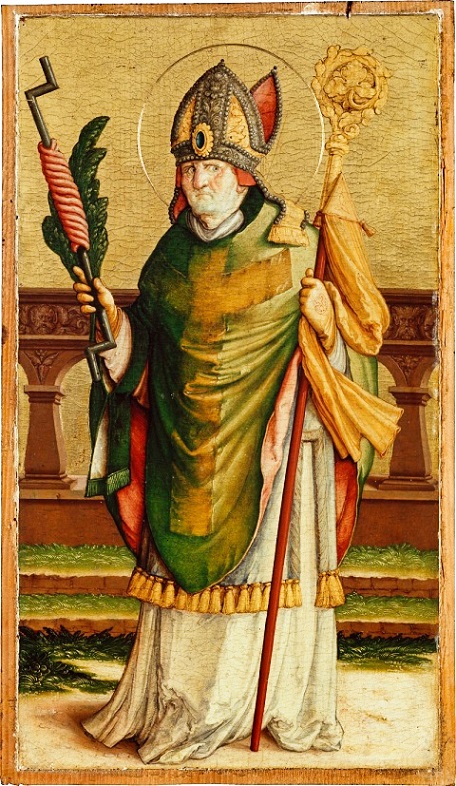
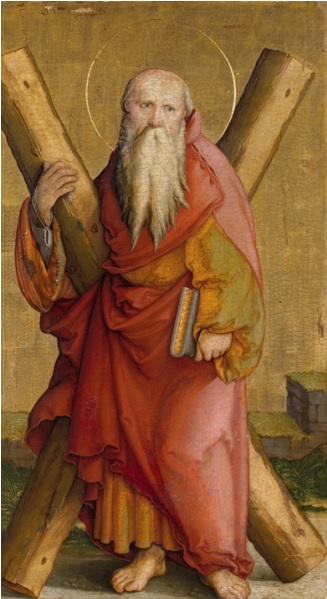
07 Religious Icons, The Meister von Meßkirch's Falkenstein Altar, Saint Anne, Saint Elmo, Saint George, Saint Christopher, Roch, John the Baptist and Andrew the Apostle, with footnotes #36

Master of Messkirch  (fl. 1520–1540)
Falkenstein Altarpiece, c. after 1530
Tempera on softwood
Johanniterkirche, Johanniterhalle Schwäbisch Hall

The Master of Meßkirch (German: Meister von Meßkirch; active c. 1515 - 1540) was an anonymous German Renaissance painter.

The so-called Master of Meßkirch is named after the eleven altarpieces he painted for the St. Martin church in Meßkirch between 1536 and 1540. His birthplace and apprenticeship are unknown, but he may have studied under an artist from the circle of Albrecht Dürer, such as Hans von Kulmbach or Hans Leonhard Schäufelein. From the 1530s onwards his works seem to display familiarity with contemporary northern Italian paintings. 

Throughout the master's career his figures had Manneristic proportions. While early on his colors were bright and iridescent, his coloration became calmer and more muted in his last years. More on The Master of Meßkirch

Master of Messkirch  (fl. 1520–1540)
Falkenstein Altarpiece, c. after 1530
Top Center; Virgin, Child and St Anne

Saint Anne (also known as Ann or Anna) of David's house and line, was the mother of the Virgin Mary and grandmother of Jesus Christ, according to apocryphal Christian and Islamic tradition. Mary's mother is not named in the canonical gospels, nor in the Qur'an. Anne's name and that of her husband Joachim come only from New Testament apocrypha, of which the Protoevangelium of James (written perhaps around 150) seems to be the earliest that mentions them. More on Saint Anne

Master of Messkirch  (fl. 1520–1540)
Falkenstein Altarpiece, c. after 1530
Soft wood
height: 49 cm (19.2 in); width: 27 cm (10.6 in)
Top Right; St. Erasmus

Erasmus of Formia, also known as Saint Elmo (died c. 303), was a Christian saint and martyr. He is venerated as the patron saint of sailors and abdominal pain. Erasmus or Elmo is also one of the Fourteen Holy Helpers, saintly figures of Christian tradition who are venerated especially as intercessors. More on St. Erasmus

Master of Messkirch  (fl. 1520–1540)
Falkenstein Altarpiece, c. after 1530
Soft wood
height: 49 cm (19.2 in); width: 27 cm (10.6 in)
Top Left; St. George


Saint George (circa 275/281 – 23 April 303 AD) was a soldier in the Roman army who later became venerated as a Christian martyr. His parents were Christians of Greek background; his father Gerontius was a Roman army official from Cappadocia and his mother Polychronia was from Lydda, Syria Palaestina. Saint George became an officer in the Roman army in the Guard of Diocletian, who ordered his death for failing to recant his Christian faith.
 
In the fully developed Western version of the Saint George Legend, a dragon, or crocodile, makes its nest at the spring that provides water for the city of "Silene" (perhaps modern Cyrene in Libya or the city of Lydda in Palistine, depending on the source). Consequently, the citizens have to dislodge the dragon from its nest for a time, to collect water. To do so, each day they offer the dragon at first a sheep, and if no sheep can be found, then a maiden is the best substitute for one. The victim is chosen by drawing lots. One day, this happens to be the princess. The monarch begs for her life to be spared, but to no avail. She is offered to the dragon, but then Saint George appears on his travels. He faces the dragon, protects himself with the sign of the Cross, slays the dragon, and rescues the princess. The citizens abandon their ancestral paganism and convert to Christianity. More on Saint George 

Master of Messkirch  (fl. 1520–1540)
Falkenstein Altarpiece, c. after 1530
Soft wood
height: 49 cm (19.2 in); width: 27 cm (10.6 in)
Bottom Left: St. Christopher

Saint Christopher is venerated as a martyr killed in the reign of the 3rd-century Roman Emperor Decius,) or alternatively under the Roman Emperor Maximinus II Dacian. There appears to be confusion due to the similarity in names "Decius" and "Dacian". However his veneration only appears late in Christian tradition, and did not become widespread in the Western Church until the Late Middle Ages, although churches and monasteries were named after him by the 7th century.

It is disputed whether Christopher existed, and if so whether the name applied to a specific person or was a general title meaning "Christ-bearer" which was applied to several different real or legendary people. He may be the same figure as Saint Menas. His most famous legend, which is mainly known from the West and may draw from Ancient Greek mythology, tells that he carried a child, who was unknown to him, across a river before the child revealed himself as Christ. Therefore, he is the patron saint of travelers. More Saint Christopher

Master of Messkirch  (fl. 1520–1540)
Falkenstein Altarpiece, c. after 1530
Soft wood
height: 49 cm (19.2 in); width: 27 cm (10.6 in)
Bottom Right: St. Rochus

Roch (lived c. 1348 – 15/16 August 1376/79), also called Rock in English, is a Catholic saint, a confessor whose death is commemorated on 16 August and 9 September in Italy; he is especially invoked against the plague. He has the designation of Rollox in Glasgow, Scotland, said to be a corruption of Roch's Loch, which referred to a small loch once near a chapel dedicated to Roch in 1506.

He is a patron saint of dogs, invalids, of falsely accused people, bachelors, and several other things. He is the patron saint of Dolo (near Venice) and Parma, as well as Casamassima, Cisterna di Latina and Palagiano (Italy).

Saint Roch is known as "São Roque" in Portuguese, as "Sant Roc" in Catalan, as "San Roque" in Spanish (including in former colonies of the Spanish colonial empire such as the Philippines) and as "San Rocco" in Italian. More on Saint Roch

Master of Messkirch  (fl. 1520–1540)
Falkenstein Altarpiece, c. after 1530
Soft wood
height: 49 cm (19.2 in); width: 27 cm (10.6 in)
Bottom second from left: St. John the Baptist

The story of John the Baptist is told in the Gospels. John was the cousin of Jesus, and his calling was to prepare the way for the coming of the Messiah. He lived in the wilderness of Judea between Jerusalem and the Dead Sea, "his raiment of camel's hair, and a leather girdle about his loins; and his meat was locusts and wild honey." He baptised Jesus in the Jordan.

According to the Bible, King Herod's daughter Salome requested Saint John the Baptist's beheading. She was prompted by her mother, Herodias, who sought revenge, because the prophet had condemned her incestuous marriage to Herod. More John the Baptist

Master of Messkirch  (fl. 1520–1540)
Falkenstein Altarpiece, c. after 1530
Soft wood
height: 49 cm (19.2 in); width: 27 cm (10.6 in)
Bottom second from right: St. Andrew

Andrew the Apostle (from the early 1st century – mid to late 1st century AD), also known as Saint Andrew was a Christian Apostle and the brother of Saint Peter.
The name "Andrew", like other Greek names, appears to have been common among the Jews, Christians, and other Hellenized people of Judea. No Hebrew or Aramaic name is recorded for him. According to Orthodox tradition, the apostolic successor to Saint Andrew is the Patriarch of Constantinople. More Andrew the Apostle 

The Master of Meßkirch (active c. 1515 - 1540) was an anonymous German Renaissance painter.

The so-called Master of Meßkirch is named after the eleven altarpieces he painted for the St. Martin church in Meßkirch between 1536 and 1540. His birthplace and apprenticeship are unknown, but he may have studied under an artist from the circle of Albrecht Dürer, such as Hans von Kulmbach or Hans Leonhard Schäufelein. From the 1530s onwards his works seem to display familiarity with contemporary northern Italian painting. Hans Baldung Grien was also influential to his work.

Early on he worked for Count Eitel Friedrich III of Hohenzollern in Veringenstadt. Later he was called to Meßkirch to work for Count Gottfried Werner von Zimmern.

Throughout the master's career his figures had Manneristic proportions. While early on his colors were bright and iridescent, his coloration became calmer and more muted in his last years. More on The Master of Meßkirch


Please visit my other blogs: Art Collector, Mythology, Marine Art, Portrait of a Lady, The Orientalist, Art of the Nude and The Canals of Venice, Middle East Artists, 365 Saints, 365 Days, and Biblical Icons, also visit my Boards on Pinterest

Images are copyright of their respective owners, assignees or others. Some Images may be subject to copyright

I don't own any of these images - credit is always given when due unless it is unknown to me. if I post your images without your permission, please tell me.

I do not sell art, art prints, framed posters or reproductions. Ads are shown only to compensate the hosting expenses.

If you enjoyed this post, please share with friends and family.

Thank you for visiting my blog and also for liking its posts and pages.

Please note that the content of this post primarily consists of articles available from Wikipedia or other free sources online.


Tuesday, November 8, 2022

1 Religious Icon, 19th C. Russian Icon of Saints Catherine , Natalya, Ann the Prophetess, Ljubov, John, and Alexander and Saint Anne, with footnotes #20

Unknown iconographer
19th C. Russian Icon with Chosen Saints
Egg tempera and gold leaf on wood
14.25" W x 17.75" H (36.2 cm x 45.1 cm)
Private collection

An icon presenting an ensemble of blessed saints, including Catherine , Natalya, Ann the Prophetess, Ljubov (Love, more commonly interpreted as Charity), John, and Alexander standing in two rows. The seventh saint is most likely John the Evangelist. Each saint is identified with a gold on blue banner, all beneath Saint Anne in the celestial realm aloft billowing clouds donning red and blue robes. More on this Icon

Saint Catherine of Alexandria is, according to tradition, a Christian saint and virgin, who was martyred in the early 4th century at the hands of the pagan emperor Maxentius. According to her hagiography, she was both a princess and a noted scholar, who became a Christian around the age of fourteen, and converted hundreds of people to Christianity. More on Saint Catherine of Alexandria

Saint Natalia's hagiography is closely tied to the life of her husband, Saint Adrian. Adrian was struck by divine grace and told the Roman officials to write his own name with the rest of the martyrs. When his wife Natalia heard that he had been imprisoned with the martyrs, she ran with joy to the gaol and lauded his resolve while embracing his chains. She imploring the other martyrs to pray to God.

When Adrian appeared before the emperor and confessed Christ, he was tutored, and killed, with the other martyrs. Their hands and feet were then cut off.  Natalie managed to steal one of her husband's severed hands from the pile. The fire that was supposed to burn the relics was miraculously put out by a sudden shower of rain, and a Christian named Eusebius was able to retrieve the relics and transport them for burial to Argyroupolis, a town near Byzantium. Some time later, Natalia visited the tomb where she gave up her soul to God and was herself subsequently buried. More on Saint Natalia

Anna the Prophetess is a woman mentioned in the Gospel of Luke. According to that Gospel, she was an elderly Jewish woman who prophesied about Jesus at the Temple of Jerusalem. She appears in Luke, during the presentation of Jesus at the Temple. More on Anna the Prophetess

Saint Ljubov, Saints Faith, Hope and Charity are a group of Christian martyred saints.  In the reign of Roman Emperor Hadrian (2nd century AD), a matron Sophia (Wisdom), with her three youthful daughters, Pistis, Elpis, and Agape (Greek for Faith, Hope and Charity), became martyrs.

The guards took Sophia's daughters one by one, from the oldest to the youngest and beat and tortured them to death in an attempt to force her to renounce her faith in Christ. She proved her unconditional faith in Christ by proving to people that she and her daughters were willing to go through hard times for their faith. Afterwards, Sophia buried her daughters' bodies and remained by their graves for three days until she died herself. More on Saint Ljubov and Saint Sofia

Saint John the Apostle, also called Saint John the Evangelist or Saint John the Divine (flourished 1st century ce), in Christian tradition, the author of three letters, the Fourth Gospel, and the Revelation to John in the New Testament. He played a leading role in the early church at Jerusalem. More on Saint John
Saint Anne (also known as Ann or Anna) of David's house and line, was the mother of the Virgin Mary and grandmother of Jesus Christ, according to apocryphal Christian and Islamic tradition. More on Saint Anne


Please visit my other blogs: Art Collector, Mythology, Marine Art, Portrait of a Lady, The Orientalist, Art of the Nude and The Canals of Venice, Middle East Artists, 365 Saints and 365 Days, also visit my Boards on Pinterest

Images are copyright of their respective owners, assignees or others. Some Images may be subject to copyright

I don't own any of these images - credit is always given when due unless it is unknown to me. if I post your images without your permission, please tell me.

I do not sell art, art prints, framed posters or reproductions. Ads are shown only to compensate the hosting expenses.

If you enjoyed this post, please share with friends and family.

Thank you for visiting my blog and also for liking its posts and pages.

Please note that the content of this post primarily consists of articles available from Wikipedia or other free sources online.